
By Cynthia B. Lauer, Master Gardener, SCMG
Blue as the sky. Blue as the sea. Blue as a robin’s egg. Blue as your beloved’s eyes. A colour favoured by many, blue is a popular hue for clothing, home décor, visual art, and many other things. People are drawn to blue. With a celebrated status like that, you’d expect that blue flowers would be everywhere.
But they are not everywhere. In fact, true blue flowers are rare.
Gardeners who want to introduce more blue flowers in their garden might start by typing in “blue flowers” into a search engine. What they discover is a long list of lovely plants featuring flowers (known as inflorescences) that are described as blue. But they are not blue. They are shades of purple.
The fuzziness in blue/purple flower colour identification likely happened when, knowing the desirability yet rarity of blue flowers, the horticultural industry simply expanded the blue category to include purple. Persuading home gardeners that the colour blue is actually a spectrum that includes purple boosts the marketability of many plants. Now the demand for “blue” plants can be easily satisfied. Most of them are undeniably beautiful. But are blue-lovers fooled by them? Probably not. Are they willing to compromise? Sometimes.
A partial list of purple-flowering plants that are often designated as blue includes agapanthus, asters, balloon flower, bellflower, false indigo, floss flower, globe thistle, grape hyacinth, common hyacinth, iris, lilac, ornamental onion, penstemon, perennial geranium, pincushion flower, rose of sharon, salvia, spiderwort, veronica, violet, and wild blue phlox.
For those gardeners whose hearts yearn for true blue flowers, here’s a list that will satisfy your quest. A few considerations:
- Opinions may vary on whether each of these is genuinely blue.
- The plants available in your local nursery may diverge from online photographs.
- Some of these plants like columbine and delphinium and hydrangea refer to a group that include individual species, varieties, hybrids, and cultivars many of which are not blue. To ensure you’re getting the blue you want, check the details.
- As with any new plant, make choices on the basis of your growing conditions—hardiness zone, sunlight, soil.
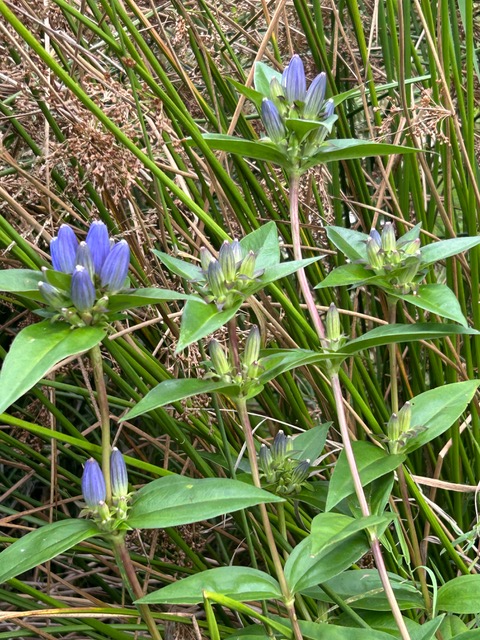
Bottle gentian. Cynthia Lauer
Blue Flowers in Native plants
Blue-eyed grass (Sisyrinchium angustifolia)
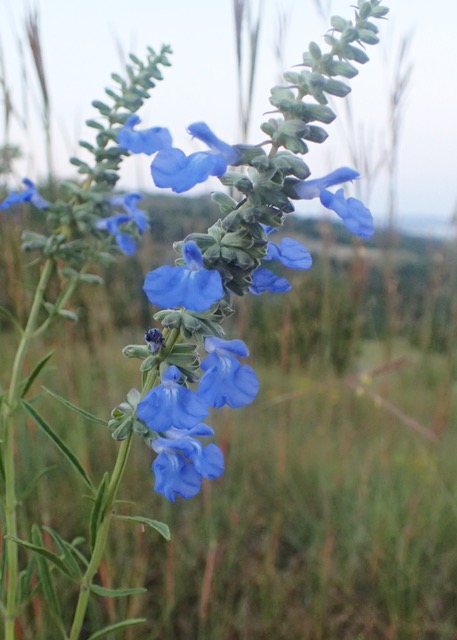
Blue sage (Salvia azurea)
Bluestar (Amsonia spp.)
Camas (Camassia quamash)
Downy skullcap (Scutellaria incana)
Flax (Linum usitatissimum)
Gentian (Gentiana spp.)
Giant blue lobelia (Lobelia siphilitica)
Jacob’s ladder (Polemonium spp.)
Monkey flower (Mimulus ringens)
Virginia bluebell (Mertensia virginica)
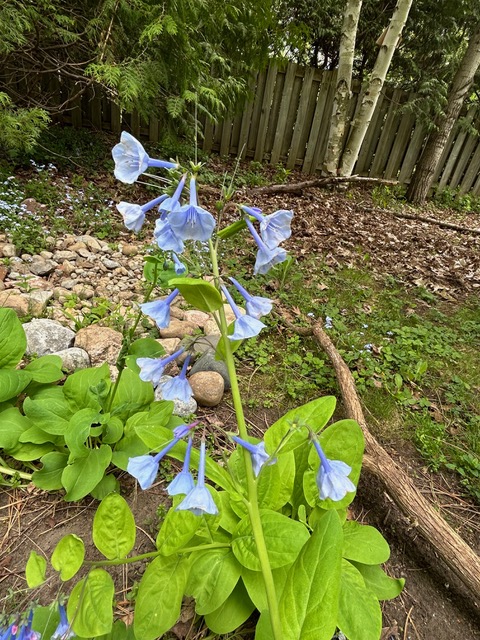
Virginia bluebell. Cynthia Lauer
Blue Flowers in Introduced Plants
Bluebeard (Caryopteris spp.)
Borage (Borago officinalis)
Brunnera (Brunnera macrophylla)
Clematis (Clematis spp. cultivars ‘Crystal Fountain,’ ‘Ice Blue,’ and ‘Arabella’)
Columbine (Aquilegia caerulea)
Cornflower (Centaurea cyanus but see the note below)
Delphinium (Delphinium spp.)
Hydrangea (Hydrangea macrophylla ‘Nikko Blue’; Hydrangea serrata)
Larkspur (Consolida ajacis)
Lungwort (Pulmonaria spp.)
Morning glory (Ipomoea purpurea)
Sea holly (Eryngium planum)
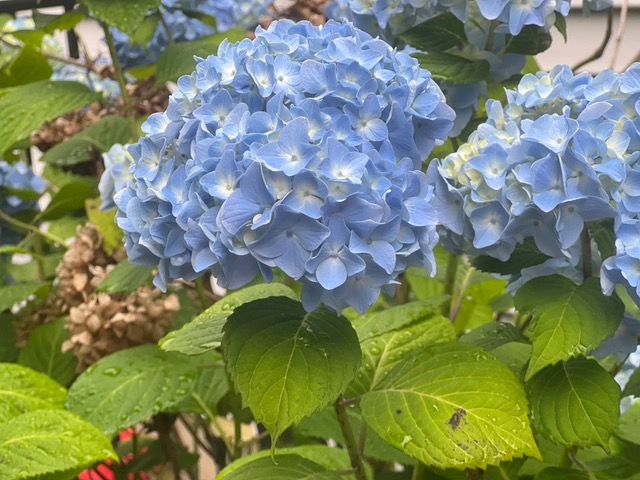
Hydrangea ‘Nikko Blue’. Michele Dorsey Walfred CC BY 2.0
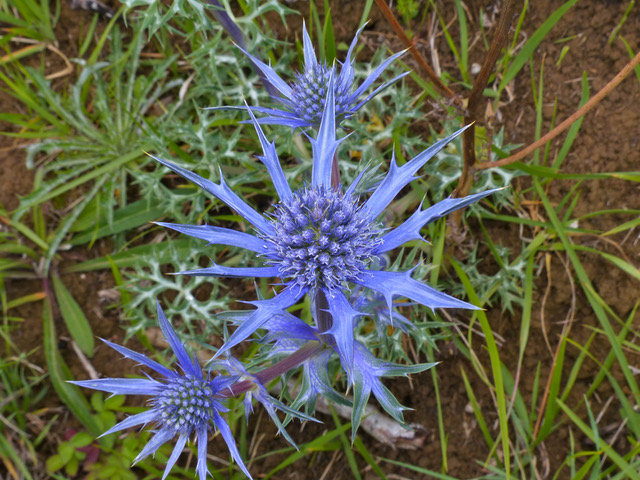
Sea holly. Berniedup CC BY-SA 2.0
Invasive Blue Flowers to Avoid
Forget-me-not (Myosotis scorpioides)
Bluets and Bachelor’s Buttons (Centaurea spp.)
Periwinkle (Vinca spp.)
Siberian squill (Scilla sibirica)
Photo Credits
Featured Image:
Blue sage. Krzysztof Ziarnek, Kenraiz CC BY-SA 4.0


