 Simcoe County Master Gardeners
Grow Natives!
PLANT PROFILE
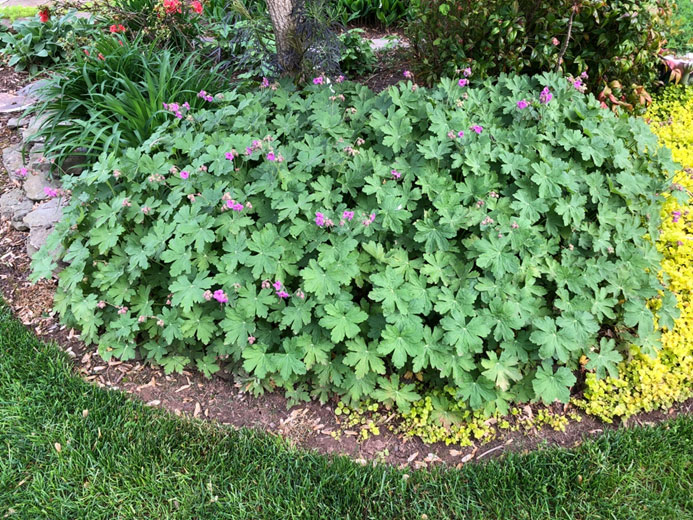
COMMON NAME: Wild Geranium, cranesbill
BINOMIAL: Geranium maculatum
| Family | Geraniaceae |
| Cdn Native Range | from MN eastward through ON, QU, NS, and NL |
| Natural habitat | open woodlands, wetlands, limestone, rocky soil, etc. |
| Type | herbaceous perennial native to deciduous woodlands |
| Features | showiest of the native geraniums; foliage can turn red in fall and stamens may curl after flowering to provide visual interest |
| Growth habit | grows in dense clumps and spreads by both seeds and rhizome; flowers more in full sun; flower buds are enclosed in winter buds at the tips of the rhizomes |
| Mature height | 30 – 46 cm, (12 – 18”) |
| Mature spread | 20 –30 cm (8 – 12”) |
| Life span | 5 – 10 years with some lasting up to 20 years under ideal conditions |
| Cdn Hardiness Zone | 3 to 9 |
| Growing conditions | Partial Sun to Part Shade. Plant in compost rich soil |
| Soil conditions | moist, well drained, soils; can tolerate clay loam and sandy loam soils |
| Watering needs | n/a |
| Fertilizer needs | compost, natural mulch |
| Tolerance | drought; salt; shade; black walnut; deer browsing; rabbit browsing |
| Maintenance rank | low |
| Maintenance needs | deadheading is not recommended as the plants don’t normally re-bloom; can be lightly sheared back and shaped after flowering |
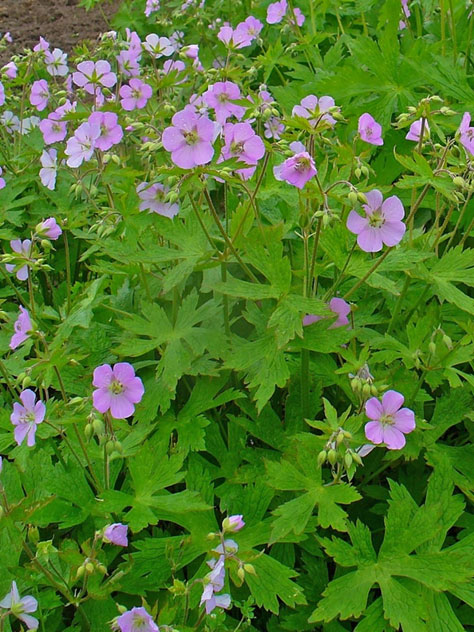
| Bloom | attractive rose pink, lavender or darker purple flowers bloom in clusters of 2–5; flowers are upturned; blooms for about one month in late spring–early summer |
| Fruit | distinct explosive fruit capsule is produced 3 to 5 weeks after flowering; turns upward and catapults seeds 3–9 m (10 to 30 ft) away from the plant |
| Pollinator support | larval host plant for the leaf mining moth and the white-marked tussock moth; important food source for the cranesbill miner and the specialist mining bee; source of nectar and pollen for the small carpenter bee, sweet or furrow bee, orchard mason bee and the fruit worm beetle |
| Environmental support | birds and small mammals eat the seeds; soil stabilization; landscape restoration |
| Garden Use | groundcover; woodland gardens, borders, rain gardens; around pond edges |
| Risks & Cautions | feeding damage from slugs and aphids; rust and leaf spots; deer browsing |
References: Native Plant Trust Plant Search, https://plantfinder.nativeplanttrust.org/Plant-Search; Native Plant Trust Go Botany, https://gobotany.nativeplantrust.org; Lorraine Johnson and Sheila Colla. A Garden for the Rusty-Patched Bumblebee: Creating Habitat for Native Pollinators