
Grow Natives!
Simcoe County Master Gardeners urges everyone to grow natives!
Native plants were here before European settlement. Having adapted physically, biochemically, and genetically to local climate and soil conditions, they are the most sustainable species to grow. Native plants are more drought-resistant and require less water and maintenance than non-native species.
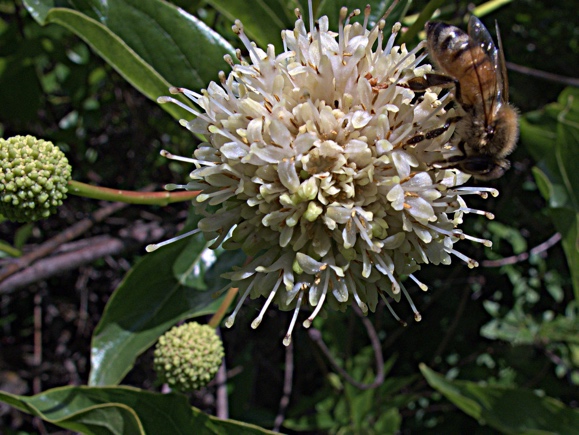
Adapted to the local environment for thousands of years, native plants have co-evolved with insects, birds, and mammals that depend on them for food and habitat. Many bees specialize on a few kinds of native plants as a larval host. Without that plant, those bees cannot survive. The more diverse your native plant garden, the more pollinators it supports.
It’s not just about bees. Native plants enable pollination but they also make many other essential contributions to local ecosystems. They improve soil health, prevent erosion, and filter water that reduces flooding. They provide food, improve air quality, regulate the temperature, conserve water, sequester carbon dioxide, store carbon and support an entire biome above and below the ground.
Growing native plants is something everyone can do to mitigate the loss of insect and bird species and to counteract the effects of climate change.
What native plants should you grow? This website has the information you need to choose, and to successfully grow, native plants. You may be looking for a big tree to occupy space, a woody shrub that looks good all year round, an elegant grass that complements your perennials, or a vine to clamber over a fence. And you probably want a lot of beautiful flowers that attract butterflies and support pollinating insects—tall ones at the back, short ones covering the ground, and medium ones to fill in everywhere else. We hear you! We invite you to explore our website and discover the native plant species that work best for you.
Where To Find Native Plants
Native plant propagation and sales are unlike large general nurseries. Growing operations are usually small in scale with no infrastructure for accessing large markets like those found at commercial nurseries and box stores. This is one reason why the availability of native plants can be challenging.
It’s one thing to promote native plants; it’s another to ensure that gardeners can get their hands on them. Here is a list that will help—twenty-two native plant growers or providers concentrated in Simcoe Region and environs (with a few located elsewhere). Offerings of plants and seeds vary widely; no one source is likely to carry everything you may want. Listed alphabetically, some offer installation and consultation services as well as educational opportunities. To our knowledge, this list is the most comprehensive one you’ll find at any site. It is our privilege to share it with you.
- Birds and Bees Native Plant Gardening https://birdsbeesgardens.ca/ Garden plans and installation; sourcing and delivery of native species; invasive plant removal; flagstone paving. Located in Innisfil ON. Contact Megan Youdelis, 905-251-0161, info@birdsbeesgardens.ca
- Earth Revival https://www.earthrevival.ca/ Seasonal in-person plant sales of native and some near-native plants. Contact Laura Bates, 206 Forest Cres, Stayner ON, L0M 1S0, earthrevivalcanada@gmail.com
- Ephemeral Ark Native Plant Nursery https://www.ephemeralark.ca/ Located in Kawartha region but delivers to Simcoe region. Minimum order $200. Contact Paul La Porte for plant catalogue, pjl@paullaporte.ca
- Fiddlehead Native Nursery http://fiddleheadnursery.ca/ Rare edible perennials nursery, workshops, consultations, garden tasting tours. Open seasonally Thu – Sun 10–5. Contact Ben Caesar, 235599 Grey Rd 13, Kimberley ON (near Collingwood), fiddleheadnursery@gmail.
- Hidden Habitat https://www.hiddenhabitat.ca/ Online retail nursery, seed packages and gift boxes, landscape design and build, rain gardens, stonework, workshops, webinars, consulting. Contact Laura Thomas, 2017 Southwood Road, Kilworthy ON P0E 1G0, 705-828-6313, info@hiddenhabitat.ca
- In Our Nature https://www.inournature.ca/ Retail nursery, garden design and maintenance, public speaker. Contact Shaun Booth, 519-216-2645, @gmail.com
- Kayanase https://www.kayanase.ca/ native plant seeds, propagation and contract growing using science-based approaches and traditional ecological knowledge. Planting and direct seeding, wildlife habitat structure production, consulting services, plant inventories. Shop in person Mon–Sun, 993 Highway #54 P.O. Box 820, Ohsweken ON, N0A 1M0, 519-770-0013, sales@kayanase.ca
- Living Green Barrie https://livinggreenbarrie.com/ Bi-annual tree and shrub fundraiser sale of selected species at reasonable cost. South Barrie location. Contact Andee Pelan, 705-715-2255, info@livinggreen.info
- Native Plants in Claremont, https://www.nativeplants.ca/ Retail and wholesale nursery; Fedex delivery; garden design; plant consultation; wildflower kits; seed packets. Owners Karen Abrahams and Rob Messervey, 4965 Westney Road, Pickering (Claremont), Ontario, L1Y 1A2 416-888-3363
- Native Plant Nurseries https://www.nativeplantnurseries.ca/ Online retail nursery with delivery or for pick up in Pefferlaw or Tottenham. Contact 416-999-7654 or 416-768-1959, nativeplantnurseries@hotmail.com
- Northern Wildflowers https://northernwildflowers.ca/ Online sale with retail distributors of native plant seeds for wildflowers, trees, shrubs, grasses and seed mixes, vegetables, fruits. Located at 2 Black Lake Road, Building B, Unit 5, Lively ON, P3Y 1C6, 705-618-4797, hello@northernwildflowers.ca
- Not So Hollow Farm https://notsohollowfarm.ca/ retail nursery, landscape architecture, online landscape coaching. Contact owners Ian Payne and Viki Reynolds, 838369 4th Line East, Mulmur ON L9V 0J7, 705-279-1578, kyle@notsohollowfarm.ca
- Ontario Flora https://www.ontarioflora.ca/ Retail and wholesale nursery, landscape design, consulting, nursery open by appointment only. Contact 585538 Sideroad 10a, RR2 Markdale ON, N0C 1H0, 519-387-7668, info@ontarioflora.ca
- Ontario Native Plants ca Online retail plants shipped or for pick up. Contact office@onplants.ca.
- Ontario Plants https://www.ontarioplants.org/ Retail perennials, fruit trees, edible plants, some unusual species. Located in Toronto and Eastern Ontario. Contact Craig Urquhart, 2028 Dundas St E, Toronto ON, 647-772-7985.
- Origin Native Plants https://www.originnativeplants.com/ Online native plants sales, ecosystem restoration, landscape expertise. Site is not open to the public. Pickup in Guelph. 5420 Hwy 6, Guelph ON, N1H 6J2, 519-760-0055, info@originnativeplants.com
- Pollin Gardens https://www.pollingardens.com/available-plants 10780 Concession 3 Rd, Zephyr, ON L0E 1T0. Link was inactive as of March 22, 2026.
- Pollinate Barrie https://pollinatebarrie.ca/ pay-what-you-can bi-annual perennial fundraiser sale partnered with Living Green Barrie. South Barrie location. Free downloadable gardens designs. Contact Ashley Hammel, facebook.com/ashley.hammell
- Stone Row Farm https://stonerowfarm.ca/ wholesale nursery of plugs, bareroot and container-grown trees and shrubs, landscape services. 1047 Gratrix Road, Waubashene ON, 705-881-7077, info@stonerowfarm.ca
- Swallowtail Native Plants https://www.swallowtailnativeplants.ca/ Wildflower and grass seeds. Located in Oak Ridges. Contact Andrea D’Silva, swallowtailnativeplants@gmail.com
- Toronto Plant Market and Native Plant Supply https://ecoman-104849.square.site/#gdEsvx Retail plant sales, design, consultation, maintenance, Wed–Fri 12–7, Sat/Sun 10–3. Located in Mississauga. Contact Jonas Spring, jonas@ecoman.ca, 327 Bering Ave, Toronto ON M8Z 3A5, 416-535-5565.
- Wildflower Farm https://www.wildflowerfarm.com/storefront.html Online sales of wildflower seeds, native grasses, and wildflower seed mixes. Not all species are native to Ontario. Shipping to North America. Mon–Fri 8–4 ET, 866-478-9453. The business is for sale.